
B2B Lead Qualification: A Practical Guide
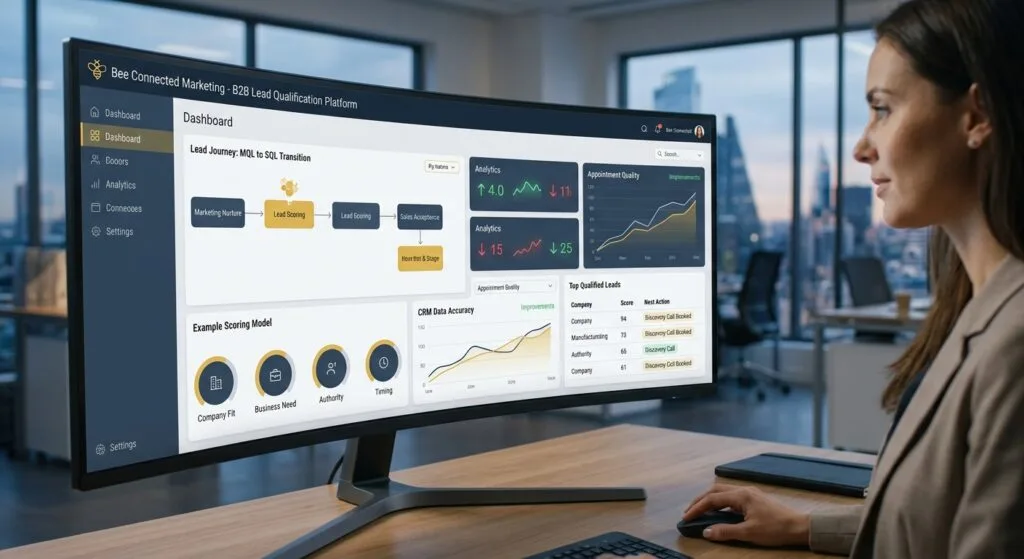
B2B Lead qualification helps appointment-setting teams identify prospects with a relevant need, suitable company profile and genuine potential for a productive sales conversation. Assessing fit, influence and timing improves appointment quality and helps sales teams focus on better opportunities.
B2B Lead Qualification: A Practical Guide
B2B lead qualification is the process of assessing whether a business and its contacts are a suitable fit for your offer, have a relevant need, and are worth progressing into a sales conversation.
Effective qualification helps sales teams focus on realistic opportunities instead of treating every contact or enquiry as equally valuable. It also improves appointment quality, CRM data, campaign reporting and the overall efficiency of business development activity.
What is B2B lead qualification?
B2B lead qualification involves gathering and evaluating information about a potential customer to determine whether they are likely to benefit from your product or service and whether a sales conversation is appropriate.
A qualified lead will usually have some combination of:
A company that fits your ideal customer profile.
A relevant business problem or objective.
A contact with an appropriate role or level of influence.
A realistic reason to consider a solution.
A suitable timeframe.
Sufficient interest to agree to a relevant next step.
Qualification does not always mean that the prospect is ready to buy immediately. In many B2B markets, a qualified prospect may still need to complete internal research, secure budget or involve other decision-makers.
The purpose is to determine whether further sales activity is justified and what the most appropriate next step should be.
Why qualification matters
Poor qualification creates problems throughout the sales process.
When unqualified leads are passed to sales, teams may spend time on organisations that:
Cannot use the solution.
Have no relevant requirement.
Are too small or too large for the offer.
Have no budget or authority.
Are not considering a change.
Are outside the service area.
Do not match the intended sector or buying profile.
This can result in:
Low appointment attendance, resulting in wasted research and preparation time.
Salespeople rejecting marketing leads, resulting in potential friction between departments.
Repeated follow-up with unsuitable contacts, wasting valuable time.
Inaccurate conversion reporting, causing frustration.
Poor customer experiences from wasting their time on an unsuitable solution.
Higher acquisition costs from the wasted time, effort, and budget.
Good qualification creates a shared standard. It clarifies which contacts should be nurtured, which should be passed to sales and which should be excluded.
MQL and SQL: what is the difference?
The terms MQL and SQL describe different stages of lead readiness.
Marketing-qualified lead
A marketing-qualified lead, or MQL, has shown enough interest or fit to justify further marketing or initial qualification activity.
An MQL might have:
Downloaded a substantial guide.
Attended a webinar.
Repeatedly visited key service pages.
Responded to an email campaign.
Requested information.
Matched important company and contact criteria.
Engaged with a campaign about a relevant business issue.
An MQL is not necessarily ready for a sales call. It has reached a threshold that suggests further assessment is worthwhile.
Sales-qualified lead
A sales-qualified lead, or SQL, has been assessed by sales or a business-development team and meets the organisation’s agreed criteria for direct sales follow-up.
An SQL will normally have:
A suitable company profile.
A relevant contact.
A recognised business need.
Some indication of timing or priority.
Sufficient authority or access to decision-makers.
Agreement to a sales conversation or other defined next step.
The exact definitions should be agreed between sales and marketing. If marketing treats every form submission as an MQL and sales treats only active projects as SQLs, the handover criteria should make that difference explicit.
MQL versus SQL
| Area | Marketing-qualified lead | Sales-qualified lead |
|---|---|---|
| Main purpose | Identify interest or potential fit | Confirm sales relevance |
| Typical owner | Marketing or marketing automation | Sales or business development |
| Evidence | Engagement, fit or enquiry | Need, authority, timing and agreed next step |
| Sales readiness | May require nurturing | Ready for direct sales activity |
| Typical action | Score, nurture or qualify | Contact, book meeting or create opportunity |
| Definition | Broader and earlier-stage | Narrower and more commercially validated |
Not every organisation uses the terms MQL and SQL. What matters is that everyone understands the lead stages and handover rules, helping teams work more efficiently and improve conversion rates.
A practical lead-qualification framework
A useful framework assesses five areas:
Company fit.
Business need.
Contact relevance.
Timing and priority.
Next-step commitment.
1. Company fit
Determine whether the organisation matches your ideal customer profile.
Useful factors may include:
Industry.
Location.
Number of employees.
Revenue or operating scale.
Target market.
Existing technology.
Relevant department structure.
Regulatory requirements.
Buying model.
Likely capacity to purchase and implement the solution.
For example, an engineering or industrial business with a complex sales cycle might prioritise organisations that:
Have a clear need for its specialist products or services.
Operate in sectors where its technical expertise is relevant.
Have suitable project requirements, production needs or operational challenges.
Work with established procurement or technical evaluation processes.
Have the budget and timescale to consider a substantial investment.
Include technical, operational or commercial stakeholders in the buying decision.
Are likely to require ongoing support, maintenance or specialist expertise.
This type of qualification helps the business focus on prospects with a realistic need and buying opportunity, rather than simply targeting organisations based on industry or company size alone.
For an outbound campaign, the content should focus less on an existing enquiry and more on identifying potential relevance during a proactive conversation. The prospect may not already have a defined project, so qualification should uncover possible needs without assuming that a purchase is already planned.
2. Business need
In an outbound campaign, establish whether the organisation may have a technical, operational or commercial challenge that your products or services could help address.
The prospect may not be actively searching for a supplier. The caller’s role is to identify relevant circumstances, priorities or future requirements through a focused conversation.
Potential indicators include:
Plans to expand production or operating capacity.
Ageing, unreliable or inefficient equipment.
Pressure to improve productivity, quality or safety.
Excessive downtime, waste, energy use or maintenance costs.
Upcoming refurbishment, replacement or investment plans.
New customer contracts or increased order volumes.
A need to enter a new market or support a new application.
Difficulty meeting technical, regulatory or compliance requirements.
Concerns about supplier reliability, lead times or technical support.
A requirement for specialist, bespoke or engineered solutions.
A future project that has not yet reached the procurement stage.
A general interest in improving a process, system or operation.
Useful outbound questions include:
“Are you currently reviewing any projects or improvements in this area?”
“Are there any planned equipment upgrades, capacity changes or operational improvements on the horizon?”
“How are you currently managing that requirement?”
The objective is not to create artificial urgency. It is to identify whether there is enough potential relevance to justify a further conversation.
3. Contact relevance
In an outbound campaign, establish whether the person has a relevant role in the operational, technical, commercial or procurement process.
Potential contacts include:
Owners and managing directors.
Technical directors.
Engineering managers.
Operations directors.
Production or manufacturing managers.
Project managers.
Procurement or purchasing managers.
Maintenance or facilities managers.
Commercial directors.
Specification engineers.
Compliance or health and safety managers.
Technical or project influencers.
The contact does not need to be the final decision-maker to gain useful insight in the first instance. They may be a useful person to speak to because they understand the organisation’s requirements, influence supplier selection or can introduce the appropriate stakeholder.
If the person is not responsible for the area, ask:
“Who normally looks after this within the business?”
You can then determine whether it is appropriate to request an introduction, obtain a referral or contact the relevant person directly.
4. Timing and priority
In outbound campaigns, the prospect may not have an active project or immediate buying requirement. Qualification should therefore distinguish between current opportunities, future potential and no meaningful relevance.
Useful timing indicators include:
A project being considered or planned.
A future plant, facility or production-line expansion.
Equipment approaching the end of its useful life.
A likely supplier review or contract renewal.
A planned maintenance or replacement programme.
Expected changes in production volume.
New customer requirements.
An upcoming investment or budget cycle.
A known regulatory, safety or compliance change.
A recurring operational problem that may require attention later.
A need that could become more important as the business grows.
Questions might include:
“Is this something you are likely to review in the next 6 to 12 months?”
“Are there any planned projects or investment decisions where this could become relevant?”
“When would be a sensible time to revisit this?”
A prospect who has no immediate requirement may still be a valid nurture opportunity. However, it should not be presented as an active sales opportunity unless there is evidence of a current project, requirement or agreed next step.
5. Next-step commitment
For an outbound campaign, the next step should match the level of interest identified during the conversation.
Appropriate next steps may include:
A short introductory call.
A discussion with a technical specialist.
A review of possible applications.
A future follow-up at an agreed time.
An introduction to the relevant technical or operational contact.
A site visit, where there is a clear reason for one.
A discussion about a planned project.
Sending relevant technical information followed by a scheduled call.
Adding the prospect to an agreed nurture process, subject to appropriate permissions and preferences.
A booked appointment should have a clear purpose. For example:
“The proposed meeting is to discuss how the company currently manages equipment maintenance, whether any replacement or upgrade plans are expected within the next year and whether a technical review would be useful.”
Avoid booking meetings simply because the prospect is willing to receive information. If there is no recognised relevance, agreed topic or reason to continue, the contact may be better recorded for future nurturing rather than counted as a qualified appointment.
Example qualification questions for outbound telemarketing
Outbound questions should be conversational, concise and relevant to the prospect’s business. They should uncover potential need without implying that the caller already knows the company has a problem.
Opening and current situation
“I’m calling because we work with X type of businesses that are reviewing equipment, capacity and operational performance. How are you currently managing this area?”
“Is this an area your business manages internally, or do you use external technical support?”
“How involved are you in decisions relating to equipment, engineering services or operational improvements?”
“Are there any changes planned in this area over the coming year?”
“Who would normally be responsible for this within your organisation?”
Exploring potential need
“Are you experiencing any challenges with reliability, maintenance, capacity or efficiency?”
“Are there any processes or systems you would particularly like to improve?”
“Have you had any recent issues with downtime, quality, operating costs or supplier support?”
“Are you expecting any changes in production levels, customer demand or facility requirements?”
“Are you considering any upgrades, replacements or new installations?”
“Are there any specialist or bespoke requirements that your current suppliers cannot easily support?”
“What tends to be the biggest challenge when addressing this type of requirement?”
Understanding future relevance
“Is this something you may review in the next six to 12 months?”
“Are there any projects, expansions or investment plans where this could become relevant?”
“Do you have a regular equipment replacement or maintenance-planning cycle?”
“Are any new contracts or production requirements likely to affect your needs?”
“When would be a sensible time for us to speak again?”
“Would this be more relevant to your current plans or a future investment period?”
Understanding decision involvement
“Who else would normally be involved in evaluating a supplier?”
“Would the engineering, operations or procurement team have an interest in this?”
“Who usually defines the technical requirements?”
“Who would need to be involved before a new supplier could be considered?”
“Would it be useful for us to speak with the person responsible for this area?”
Agreeing the next step
Where a current or emerging need is identified:
“Would a short introductory discussion with a technical specialist be useful?”
“Would you be open to discussing the areas you may review over the coming year?”
“Would it make sense to arrange a conversation with you and the person responsible for the project?”
“Would you prefer to speak now, or would a later date be more appropriate?”
“What would you like the discussion to cover?”
“Would Tuesday morning or Thursday afternoon be more convenient?”
Where there is no immediate need:
“Would it be helpful to send a brief overview and revisit this nearer to your planning period?”
“When would be a more appropriate time to contact you?”
“Is there a particular project, budget cycle or event that would make a future conversation more relevant?”
How to classify outbound outcomes
Outbound campaigns benefit from separating different levels of interest.
| Outcome | Description |
|---|---|
| Not relevant | No clear fit or potential need identified |
| Potential fit | Organisation appears suitable but no current need established |
| Future opportunity | Possible future project, review or investment identified |
| Nurture | Relevant organisation requiring a planned future follow-up |
| Qualified conversation | Current or emerging need discussed with a relevant contact |
| Qualified appointment | Relevant contact agrees to a defined meeting with a clear purpose |
| Sales opportunity | Active requirement is sufficiently developed for sales progression |
This prevents callers from treating every positive response as a qualified appointment.
Revised outbound qualification principle
For outbound campaigns, the key question is not:
“Does this prospect already want to buy?”
It is:
“Does this organisation fit our target profile, and have we identified enough current or future relevance to justify a meaningful next conversation?”
That approach is more realistic for complex engineering and industrial sales. It recognises that many prospects will not be actively searching when contacted, while still maintaining a clear standard for what counts as a qualified lead or appointment.
Qualification in a telemarketing conversation
A telemarketing conversation should not attempt to complete a full sales discovery process. Its purpose is to determine whether there is enough relevance to justify the next step.
A simple conversation structure is:
Confirm that you are speaking to the relevant person.
Explain why you are calling.
Ask about the current situation.
Explore the business issue.
Check fit and decision involvement.
Establish timing.
Agree or decline the next step.
Record accurate notes.
For example:
“We work with engineering and industrial companies to improve equipment performance, production capacity and operational efficiency. I wanted to find out how you currently manage this area and whether you have any planned projects, upgrades or improvement programmes where specialist support may be relevant.”
If the prospect describes a relevant issue, the caller can explore it further:
“You mentioned that equipment reliability and unplanned downtime are ongoing concerns. Are you currently considering any maintenance improvements, equipment upgrades or replacement projects to address this, either now or within the next 6 to 12 months?”
The purpose is not to force a meeting. It is to determine whether the conversation has enough relevance, fit and commitment to justify one.
Common data-quality problems
Qualification is only as reliable as the data supporting it. Poor-quality records can result in wasted calls, inaccurate targeting and misleading campaign results.
Inaccurate contact details
Common issues include:
Incorrect telephone numbers.
Disconnected lines.
Invalid email addresses.
Old job titles.
Contacts who have left the business.
Duplicate records.
Personal numbers recorded as business numbers.
Incomplete company data
Important missing information may include:
Company size.
Industry.
Website.
Geographic location.
Parent or subsidiary relationship.
Existing technology.
Target market.
Current supplier.
Relevant business unit.
Unclear or outdated roles
A contact may still appear to be relevant even though:
They have changed departments.
They no longer influence the decision.
Their title has changed.
They have moved to another company.
The business has reorganised responsibility for the area.
Poorly recorded qualification notes
Notes such as “interested,” “call back” or “good lead” are not enough to support an effective handover.
Good notes should explain:
What the prospect said.
What problem was identified.
Why the issue matters.
Who is involved.
What timing was discussed.
What next step was agreed.
Any objections or limitations.
Duplicate and conflicting records
Duplicate records can cause:
Multiple callers contacting the same business.
Conflicting qualification statuses.
Incorrect attribution.
Repeated messages.
Inflated lead and appointment numbers.
Establish a process for matching, merging and updating records before a campaign begins.
Recommended CRM fields
Your CRM should capture enough information to support qualification without making the process unnecessarily complicated.
Company fields
Company name.
Website.
Industry.
Employees or employee range.
Revenue range.
Location.
Target market.
Account owner.
Ideal-customer-profile status.
Existing technology or CRM.
Current supplier or approach.
Parent-company relationship.
Contact fields
Full name.
Job title.
Department.
Seniority.
Email address.
Telephone number.
Decision-making role.
Preferred contact method.
- Consent or communication-preference information where applicable.
Qualification fields
Lead source.
Lead stage.
Company-fit score.
Need score.
Authority or influence score.
Timing.
Priority.
Current challenge.
Desired outcome.
Budget information, where volunteered.
Other stakeholders.
Qualification status.
Disqualification reason.
Next action.
Next-action date.
Activity and outcome fields
Last contact date.
Last contact method.
Number of contact attempts.
Conversation outcome.
Appointment date.
Appointment attendance.
- Opportunity created.
Proposal issued.
Closed outcome.
Reason lost.
Use controlled values where possible. For example, a “lead status” field with agreed options is generally more useful for reporting than allowing every user to type their own description.
How qualification affects appointment quality
Strong qualification improves appointment quality in several ways.
Better relevance
The salesperson is more likely to speak to a prospect who has a problem connected to the service being offered.
Higher attendance
Prospects who fully understand the purpose of a meeting and have agreed that the topic is relevant are more likely to attend.
More productive conversations
The salesperson begins with useful context instead of repeating basic discovery questions or explaining why the meeting was arranged.
Better stakeholder involvement
Qualification can identify whether another person should attend, reducing the risk of holding an exploratory meeting with someone who cannot progress the discussion.
More accurate campaign reporting
When qualification criteria are consistent, you can distinguish between:
Raw contacts.
Engaged prospects.
Qualified leads.
Booked appointments.
Attended appointments.
Genuine opportunities.
Won customers.
This helps identify which campaigns, markets, messages and data sources produce best commercial value.
Fewer rejected appointments
A clear qualification standard reduces the number of meetings rejected by sales because of poor fit, lack of need or insufficient authority.
Example qualification scoring model
A simple scoring model can help teams apply criteria consistently.
| Criterion | 0 points | 1 point | 2 points |
|---|---|---|---|
| Company fit | Outside target profile | Partially suitable | Strong fit |
| Business need | No relevant need | General interest | Specific business issue |
| Contact role | No influence | Some involvement | Decision-maker or key influencer |
| Timing | No timeframe | Possible future project | Active or planned initiative |
| Next step | No commitment | Informal follow-up | Agreed meeting or action |
A business might define a qualified lead as one scoring at least 7 out of 10, with additional minimum requirements such as:
A suitable company fit.
A relevant business need.
A verified contact.
A defined next action.
The scoring model should be tested against actual sales outcomes. If high-scoring leads do not create opportunities, adjust the criteria rather than assuming the problem is only with the sales team.
MQL and SQL handover example
A practical handover for an outbound campaign might work like this:
Marketing identifies a UK-based engineering company that matches the agreed target profile.
The company operates in a relevant sector and has an established technical, production or operations function.
The CRM records the company, relevant contacts, campaign source and available firmographic information.
An outbound telemarketing team contacts the business and speaks with an engineering, operations, procurement or commercial stakeholder.
The contact explains that the company expects to review equipment, production capacity or operational performance over the coming year.
The conversation identifies a potential requirement, such as improving reliability, replacing ageing equipment or supporting a planned expansion.
The contact confirms who else would be involved in evaluating a solution.
A technical or introductory meeting is arranged with a clear purpose and agreed timeframe.
The salesperson or technical specialist receives the qualification notes, relevant background and agreed meeting agenda.
The lead is accepted, progressed, placed into a future nurture process or rejected using an agreed reason.
This process creates a clear evidence trail from initial outbound contact to sales outcome. It also distinguishes between a current sales opportunity, a future project and a prospect that is simply a good fit but has no identified requirement.
Lead qualification checklist
Before passing an outbound lead to sales, ask:
Does the company fit the agreed target profile?
Is the contact information accurate and up to date?
Does the contact have a relevant technical, operational, commercial or procurement role?
Has a current or potential business, operational or technical need been identified?
Is the need connected to the products or services being offered?
Has the prospect indicated a relevant project, improvement priority or future requirement?
Has the likely timeframe been discussed?
Is there a credible reason to continue the conversation?
Are other technical, operational or procurement stakeholders known?
Has the appropriate next step been agreed?
Does the meeting or follow-up have a clear purpose?
Are the qualification notes detailed enough for sales or a technical specialist to act?
Has the correct lead source and campaign been recorded?
Has the outcome been classified correctly as current opportunity, future opportunity, nurture or not qualified?
If several answers are “no,” the lead may be better suited to further nurturing, data enrichment or a planned future follow-up rather than immediate sales progression.
A prospect does not need to have an immediate purchase requirement to be valuable in an outbound campaign. However, the record should clearly state whether there is a current project, an emerging need, a future opportunity or simply a good-fit organisation requiring further development.
Create your own qualification standard
The best qualification framework reflects your market, average deal value, sales cycle and delivery model.
Start by reviewing recent leads and appointments:
Which ones became opportunities?
Which ones became customers?
Which were rejected by sales?
What characteristics did successful opportunities share?
Which qualification questions would have identified poor-fit prospects earlier?
Which data fields were missing?
Which sources produced the best commercial outcomes?
Use those findings to define your criteria and update them regularly.
A qualification framework should be specific enough to improve consistency but flexible enough to accommodate different buying situations. A small business beginning to explore a need may still be valuable, even if it does not yet meet the criteria for an immediate sales opportunity.
Improve your B2B lead generation
Effective lead qualification should be built into the entire campaign, from targeting and data preparation through to telemarketing, CRM updates and sales follow-up.
Bee Connected Marketing helps B2B organisations identify suitable prospects, improve lead data, qualify business opportunities and create more relevant sales conversations through targeted outbound marketing and appointment-setting campaigns.
Find out more about our B2B lead generation services.
Final thoughts
B2B lead qualification is not about finding a perfect prospect or forcing every contact into a sales pipeline. It is about making a clear, evidence-based decision about whether a business is suitable, whether a relevant need exists and whether a defined next step is worthwhile.
When marketing, telemarketing and sales teams use the same criteria, businesses can reduce wasted effort, improve appointment quality and make their pipeline reporting more reliable.
All Services
Speak to Our Team

Ready to Build Your Qualified Lead Pipeline?
Every day without a strategic outbound marketing approach is a day of missed opportunities with decision-makers. Let's change that. Contact us today to book your complimentary strategy consultation — a genuine, no-obligation conversation about how Bee Connected Marketing can accelerate your growth.