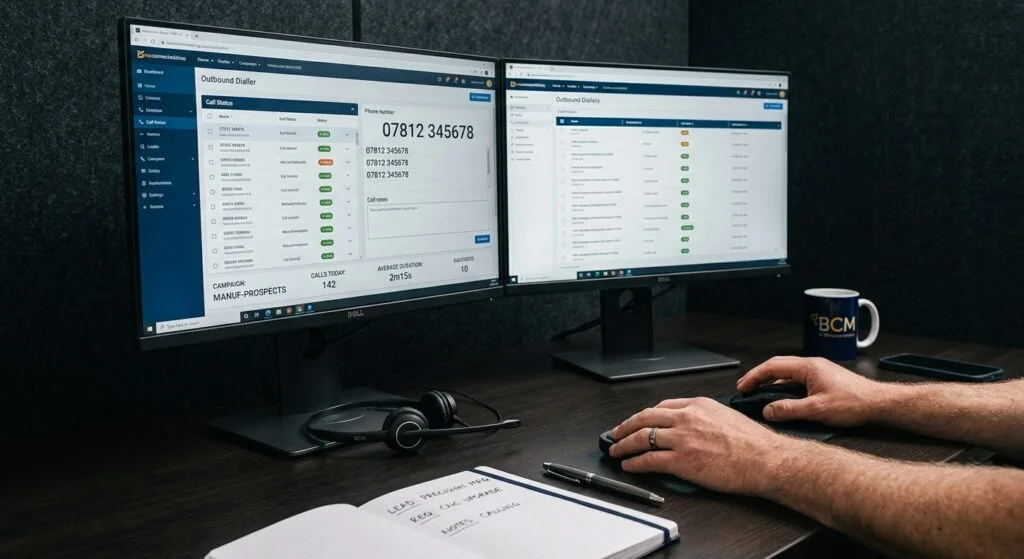
Outbound campaigns can help engineering and industrial companies reach potential customers before they begin actively searching for a supplier. However, success depends on more than identifying businesses in a suitable sector. The prospect must also have a relevant operational, technical or commercial reason to continue the conversation.
Start with the right company profile
The first stage is identifying organisations that are likely to benefit from your products or services. This may involve reviewing factors such as industry, location, production activity, company size, installed equipment, target markets and likely purchasing requirements.
A suitable prospect might be:
-
An engineering business expanding its production capacity.
-
A manufacturer with ageing or inefficient equipment.
-
An industrial company entering a new market.
-
An organisation with demanding technical or compliance requirements.
-
A business likely to require specialist components, systems or ongoing support.
Company fit does not prove that a sales opportunity exists. It simply establishes that the organisation is worth contacting. Qualification begins when the outbound conversation explores whether the business has a relevant current or future requirement.
Identify a genuine business need
Industrial prospects may not describe their situation as a “sales opportunity”. They may instead mention operational symptoms such as downtime, maintenance costs, production constraints, quality issues or difficulty meeting customer deadlines.
A telemarketing conversation should explore whether those symptoms connect to a problem that your company can address. Useful questions include:
-
Are you planning any equipment upgrades or replacements?
-
Are production capacity or efficiency areas you are currently reviewing?
-
Are there any recurring maintenance or reliability issues?
-
Have new customer requirements created additional technical demands?
-
Are you expecting any facility, process or investment changes?
The aim is not to persuade the prospect that a problem exists. It is to understand whether a relevant issue, project or future priority is already present.
Establish the contact’s role
Complex engineering and industrial purchases often involve several stakeholders. A technical manager may define the requirements, an operations director may own the business problem, procurement may manage the supplier process and finance may approve the investment.
The person contacted does not need to be the final decision-maker. They should, however, have a meaningful role in the situation or be able to introduce the person who does.
Useful questions include:
-
Who normally manages this area?
-
Who defines the technical requirements?
-
Who evaluates potential suppliers?
-
Who would be involved in approving an investment?
-
Would anyone from engineering, operations or procurement need to join a follow-up discussion?
Understanding the buying group early helps prevent appointments with people who cannot progress the discussion.
Assess timing without creating false urgency
Outbound qualification should not assume that a prospect is ready to buy. Engineering and industrial sales cycles can involve planning, technical assessment, budgeting, tendering and procurement approval.
A prospect may have:
-
An active project.
-
A planned replacement programme.
-
A future expansion.
-
A supplier review approaching.
-
A potential requirement within the next 6 to 12 months.
-
No current project but a good fit for future contact.
Ask when the organisation expects to review the issue and what event might trigger action. A future opportunity can be valuable, but it should be recorded accurately rather than reported as an immediate sales opportunity.
Agree a meaningful next step for the industrial prospects
A positive response does not automatically justify a sales appointment. The next step should have a clear purpose and be appropriate to the prospect’s level of interest.
Potential next steps include:
-
An introductory call with a technical specialist.
-
A discussion about a planned project.
-
A review of specifications or drawings.
-
A site visit.
-
A conversation with procurement or operations.
-
A future follow-up aligned with the prospect’s planning cycle.
-
Sending relevant information followed by a scheduled call.
Before booking a meeting, confirm who will attend, what will be discussed and what information may be useful. This gives the salesperson or technical specialist enough context to prepare properly.
Record qualification information accurately
Good CRM notes should describe what the prospect said, not simply label them “interested”. Record the organisation’s fit, the potential need, the contact’s role, likely timing, other stakeholders and agreed next action.
For example:
The manufacturer is considering a production-line upgrade during the next financial year. The engineering manager is assessing options and expects procurement to become involved once the specification is agreed. A follow-up discussion has been requested in September to review possible technical approaches.
This is more useful than:
Interested in equipment upgrade. Call back later.
Accurate records also help sales and marketing distinguish between current opportunities, future projects, nurture contacts and unsuitable prospects.
The value of consistent qualification with industrial prospects
A consistent qualification process improves outbound campaign performance because it aligns targeting, telemarketing, CRM management and sales follow-up. It helps teams focus on organisations where there is both a credible fit and a reason to continue the conversation.
For a detailed framework covering qualification criteria, outbound questions, CRM fields and appointment quality, see our guide to B2B lead qualification for engineering and industrial companies.